Thursday, September 6, 2007
REMINDERS TO VE011 STUDENTS
CLASS... I HOPE YOU'RE STILL CHECKING MY BLOG... IT'S NOT ENOUGH THAT YOU CREATE A BLOG IF IT DOESN'T HAVE ANY CONTENT OTHER THAN YOUR PROFILE, OKAY? THERE ARE STILL A LOT OF STUDENTS WHO HAVEN'T COMPLIED WITH THE REQUIREMENTS...

Thursday, August 30, 2007
TO MY DEAREST VE 011 STUDENTS
Hi guys! The trimester has almost ended. Despite the aching muscles and constant worries that I experienced during this first term of my teaching career, I will never trade having been one of the people who guided you on your first journey towards becoming full-pledged achievers and responsible citizens. It hasn't been easy guys. I have to be honest with you, as I think you were with me. Just like you, sometimes I felt like giving up. I was constanly wondering whether my students were getting the information they needed. Was I really pushing them to be their best? My greatest fear right now is having to fail some students. And I also don't know if I have enough stregnth to see through this. The spirit is strong, but sometimes the ephemeral body won't cooperate. But I have to hold on. Because I cannot preach what I don't practice. And as I want you to hold on to your dream as steadfastly as you could, inspite of the possible disappointments ahead, I'll try to do the same. I really believe that all of us is capable of greatness although there are limitations to what we can do at a single time. So even though I encourage you to do your very best, your health should always come first. Drink your vitamins, okay? And have enough rest. All the success you might achieve in the future will be useless if you won't be able to live to see it multiply, to see your success give birth to many more successes, perhaps through your future children or mentees.
You know what's the hardest thing for some teachers? It's having to fail students -- especially on their first year of teaching... But if we will merely let a student pass just because we pity him or her, we will be committing the same mistakes that the others before us did. All of us have to experience dying at some point in our lives, for us to be reborn and feel the rush of being able to breathe again.
I just want to thank you for at least going through this learning process with me. I was learning a lot as much as I hope you were. If in the future, it turns out that God has a different plan for me, perhaps through this blog, we can still keep in touch with each other. God bless! And I hope to bump against you in the future with contented smiles pasted on your faces which seem to say that, "Even if life isn't easy, I'm on the right track because my other hand is held by God."
****************************************
What you have to do for your blogs is show how values education has changed or improved you as a person. You can also illustrate there what you've become since you entered college. This is aside from the journal entries that you have not sumbitted to me... Take care!
Your last journal entry is supposed to be your reflection on relationships (between boyfriend and girlfriend or between friends). What lessons have you learned from your past experiences, if any? How do you make a relationship work? What advice can you give to people?
A short reminder: A person who really loves you will put your welfare first before his or hers. That person will also not lure you to destruction. Always make God the center of your lives. Don't make the same mistakes...
Thursday, August 23, 2007
VE011 - TALENT SHOW PIX
SORRY GUYS FOR UPLOADING THIS JUST NOW... ANYWAY, CONGRATULATIONS TO THOSE WHO DID WELL AND TOOK THE ACTIVITY SERIOUSLY. I ENJOYED WATCHING YOU GUYS PERFORM. GOD BLESS... ENJOY!!!
A61


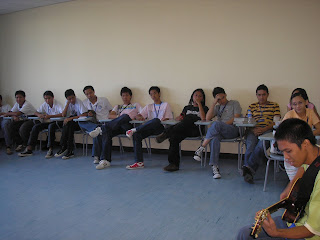


AO4


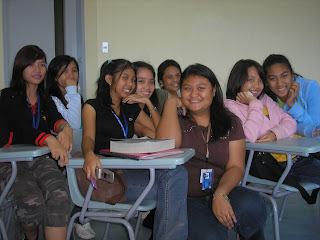

A05


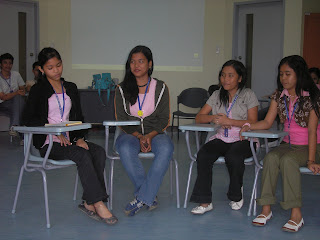


A51


BLOG/ JOURNAL ENTRY FOR THE 9TH/10TH MEETING - NEGATIVE PEER PRESSURE
1.Cite one experience wherein you have experienced negative peer pressure.
2.How did you react to it? Why?
3. How did you feel about your reaction/decision?
4. What have you learned/realized from your experience?
2.How did you react to it? Why?
3. How did you feel about your reaction/decision?
4. What have you learned/realized from your experience?
BLOG/JOURNAL ENTRY FOR 8TH MEETING - HONESTY
I. Challenge yourself
Choose a challenge:
a. Tell the truth
b. Return recovered things (personal items, money, etc)
c. Admit mistake
d. Return excess change
e. Avoid cheating
On your journal, process your experience with the aid of the following guide questions:
a. What challenge did you take?
b. Were you able to do the challenge? How did you feel about it?
c. What have you realized/learned from your experience?
Saturday, July 28, 2007
7TH MEETING VE011
7th Meeting
Part A. Respect for Physical/Mental Health
What's the big deal about 'under age' drinking?
Facts about alcohol. Alcohol is A drug that works directly on the central nervous system. Alcohol kills more male teenagers and young men than any other drug taken to affect mood and behavior. Most deaths and injury due to alcohol are caused by the way people behave when under its influence. Men fight more, drive more recklessly, and engage in more risky behaviors. Alcohol use is a leading risk factor for the three leading causes of death among youth: unintentional injuries (including motor vehicle crashes and drowning), suicides; and homicides. Alcohol also puts you at a greater risk to engage in sexual behavior which sometimes results to- a sexually transmitted disease or an unwanted pregnancy!
Alcohol intake and teen health
Because the body changes so much as we grow, the ability both to judge and cope with alcohol changes all the time. Everyone seems to know of someone who can drink booze by the bucket-load but this shouldn't be seen as something to aspire towards. Teens are the most likely group to have their stomachs pumped after excessive alcohol intake. At the end of the day, it has to be remembered that alcohol is a toxin.
Effects of excessive Alcohol on young bodies
- Youthful 'immature' organs can literally be poisoned by alcohol.
- The liver can be damaged. It takes a few days for it to recover and to get back to normal functioning after a 'session'.
- The heart can beat so irregularly that it can stop.
- The body can lose temperature causing hypothermia. Every year some teens die when they get drunk and pass out in the freezing cold.
- Too little sugar in the body can cause coma and seizures.
- Breathing can become so shallow or slow that it can stop.
- One of the most common ways in which teens (and adults) die from alcohol is by choking on their own vomit. If you vomit when you are unconscious you can easily breathe it in. If your body cannot get the oxygen it needs, brain damage or death results.
Knowing when to stop drinking alcohol
One of the dangers of drinking is not recognizing when you have had too much. Different drinks have varying alcohol content and the body reacts differently to alcohol according to whether or not you have eaten, how thirsty you are, or even what the time of day it is. Even if you stop drinking, the level of alcohol can continue increasing. No amount of coffee, cold baths, showers, or trying to walk it off will stop it. Taking a meal before drinking only slows the process. Once alcohol gets to the small intestine the effects kick in. The only thing that reverses the effect of alcohol is time.
Source: "Alcohol and Public Health." National Center for Chronic Disease Prevention and Health Promotion. 31 Jan 2005. Centers for Disease Control and Prevention. 29 Nov 2006
Research: Alcohol Damages the Teen-age Brain
June 2, 2000 -- Researchers have just come up with another reason to warn teen-agers not to drink alcohol: Specialized brain imaging studies have shown that teens and young adults, who drank heavily over long periods of time, showed shrinkage of an area of the brain that is responsible for memory and learning. This shrinkage was not seen in teens who did not drink.
The risk of this type of damage is greatest in those who begin drinking at a younger age and those who drink for longer periods of time, according to the study.
"Only in recent years have we have known the extent of brain development during adolescence," says co-author of the study, Duncan B. Clark, MD, PhD. "The hippocampus is one of the areas that's rapidly changing at this time and may be particularly affected by alcohol."
But Clark also suggests that the toxic effects of alcohol on the brain might be reversible, especially if the alcohol use is discontinued early.
Susan F. Tapert, PhD, a research scientist with the Veterans Medical Research Foundation and the University of California at San Diego, reviewed the study for WebMD. "We still need more studies, but it looks like there's a good possibility that drinking heavily during the teen-age years could affect your ability to remember things and learn new things," she says. "If you want to do well in school and be able to remember all kinds of things that you learn, it's best to avoid any kind of heavy drinking."
Many people may be surprised to learn that the brain is still developing during the teen years. "Adolescence is a period during which we now know the brain continues to rapidly develop," Clark says. "We know that alcohol can damage the brain. Adolescent alcohol abuse and dependence may have a damaging effect on adolescent brain development, and it is possible that these effects have lifelong adverse consequences.
In this report in the June issue of the American Journal of Psychiatry, a special brain scan, called an MRI, was used to measure differences in the sizes of various brain regions in 12 adolescents and young adults who used alcohol excessively, and 24 healthy youngsters who had no drinking problems.
The researchers focused on measuring the size of an area of the brain, the hippocampus, which is known to be sensitive to the effects of alcohol in adults. The hippocampus is associated with learning and memory functions, Clark says. Two hippocampi are found in the brain, one on the right side and the other on the left side.
Both the right and left hippocampi were smaller in teens with drinking problems in comparison with the normal controls. "The difference was fairly substantial, about a 10% difference, which for this area of the brain is a major difference," Clark says. The shrinkage was limited to the hippocampus; no differences were found in other brain areas.
The shrinkage of the hippocampus was greatest in those who began drinking at an early age and in those individuals who were long-time abusers. The authors say the findings suggest that, during adolescence, the hippocampus may be particularly susceptible to the effects of alcohol.
Clark says that studies conducted in animals, as well as on adults with longstanding alcohol use disorders, suggest that alcohol consumption causes the brain damage. Other explanations, however, may be possible. For instance, the brain changes may have preceded the alcohol consumption and contributed to the onset of the alcohol abuse. Or another risk factor may have caused both the drinking behavior and brain changes.
Clark says that at this early stage, it is difficult to say whether brain changes or alcohol abuse come first. He says that longitudinal studies are needed to confirm and expand the findings.
(Source: WebMD Better Information. Better Health)
Cigarette Smoking
Health Effects of Smoking
Each year, a staggering 440,000 people die in the US from tobacco use. Nearly 1 of every 5 deaths is related to smoking. Cigarettes kill more Americans than alcohol, car accidents, suicide, AIDS, homicide, and illegal drugs combined.
Cigarette smoking accounts for at least 30% of all cancer deaths. It is a major cause of cancers of the lung, larynx (voice box), oral cavity, pharynx (throat), and esophagus, and is a contributing cause in the development of cancers of the bladder, pancreas, liver, uterine cervix, kidney, stomach, colon and rectum, and some leukemia.
About 87% of lung cancer deaths are caused by smoking. Lung cancer is the leading cause of cancer death among both men and women, and is one of the most difficult cancers to treat. It is very hard to detect when it is in the earliest, most treatable stage. Fortunately, lung cancer is largely a preventable disease. Groups that promote nonsmoking as part of their religion, such as Mormons and Seventh-day Adventists, has much lower rates of lung cancer and other smoking-related cancers.
But cancers account for only about half of the deaths related to smoking. Smoking is also a major cause of heart disease, bronchitis, emphysema, and stroke, and contributes to the severity of pneumonia. Tobacco has a damaging affect on women's reproductive health and is associated with increased risk of miscarriage, early delivery (prematurity), stillbirth, infant death, and is a cause of low birth weight in infants. Furthermore, the smoke from cigarettes has a harmful health effect on those around the smoke.
Based on data collected from 1995 to 1999, the CDC estimated that adult male smokers lost an average of 13.2 years of life and female smokers lost 14.5 years of life because of smoking.
But not all of the health problems related to smoking result in deaths. In the year 2000, about 8.6 million people were suffering from at least one chronic disease due to current or former smoking, according to the CDC. Many of these people were suffering from more than one smoking-related condition. The diseases occurring most often were chronic bronchitis, emphysema, heart attacks, strokes, and cancer.
Cigarettes, cigars, and smokeless and pipe tobacco consist of dried tobacco leaves, as well as ingredients added for flavor and other properties. More than 4,000 individual compounds have been identified in tobacco and tobacco smoke. Among these are more than 60 compounds that are known carcinogens (cancer-causing agents).
Health Benefits of Smoking Cessation (Quitting)
In September 1990, the US Surgeon General outlined the benefits of smoking cessation:
Smoking cessation has major and immediate health benefits for men and women of all ages. Benefits apply to persons with and without smoking-related disease.
Former smokers live longer than continuing smokers. For example, persons who quit smoking before age 50 have one-half the risk of dying in the next 15 years compared with continuing smokers.
Smoking cessation decreases the risk of lung cancer, other cancers, heart attack, stroke, and chronic lung disease.
Women who stop smoking before pregnancy or during the first 3 to 4 months of pregnancy reduce their risk of having a low birth weight baby to that of women who never smoked.
The health benefits of smoking cessation far exceed any risks from the average 5-pound (2.3-kg) weight gain or any adverse psychological effects that may follow quitting.
The risk of having lung cancer and other smoking-related cancers is related to total lifetime exposure to cigarette smoke, as measured by the number of cigarettes smoked each day, the age at which smoking began, and the number of years a person has smoked.
The risk of having lung cancer and other cancers can be reduced by quitting. The risk of lung cancer is less in people who quit smoking than in people who continue to smoke the same number of cigarettes per day, and the risk decreases as the number of years since quitting increases.
People who stop smoking at younger ages experience the greatest health benefits from quitting. Those who quit by age 35 avoid 90% of the risk due to tobacco use. However, even smokers who quit after age 50 substantially reduce their risk of dying early. The argument that it is too late to quit smoking because the damage is already done is not true.
(Source: American cancer Society Inc.)
Part 2: Care for Environment
Ten Basic Tips To Help Stop Global Warming
(Earth 911, What can I do to help prevent Global Warming?)
Don't have a lot of times, but want to take action? Here are ten, simple, everyday things each of us can do to help stop Global Warming. Pick one, some, or all. Every little effort helps and adds up to a whole lot of good.
1. Change a light. Replacing a regular light bulb with a compact fluorescent one saves 150 pounds of carbon dioxide each year.* Learn more about these bulbs and how to properly dispose of these bulbs when they do burn out.
2. Drive less. Walk, bike, carpool, take mass transit, and/or trip chain. All of these things can help reduce gas consumption and one pound of carbon dioxide for each mile you do not drive.
3. Recycle more and buy recycled. Save up to 2,400 pounds of carbon dioxide each year just by recycling half of your household waste. By recycling and buying products with recycled content you also save energy, resources and landfill space!
4. Check your tires. Properly inflated tires mean good gas mileage. For each gallon of gas saved, 20 pounds of carbon dioxide are also never produced.
5. Use less hot water. It takes a lot of energy to heat water. Reducing the amount used means big savings in not only your energy bills, but also in carbon dioxide emissions. Using cold water for your wash saves 500 pounds of carbon dioxide a year, and using a low flow showerhead reduces 350 pounds of carbon dioxide. Make the most of your hot water by insulating your tank and keeping the temperature at or below 120.
6. Avoid products with a lot of packaging. Preventing waste from being created in the first place means that there is less energy wasted and fewer resources consumed. When you purchase products with the least amount of packaging, not only do you save money, but you also help the environment! Reducing your garbage by 10% reduces carbon dioxide emissions by 1,200 pounds.
7. Adjust your thermostat. Keeping your thermostat at 68 degrees in winter and 78 degrees in summer not only helps with your energy bills, but it can reduce carbon dioxide emissions as well. No matter where you set your dial, two degrees cooler in the winter or warmer in the summer can mean a reduction of 2,000 pounds of carbon dioxide a year.
8. Plant a tree. A single tree can absorb one ton of carbon dioxide over its lifetime.
9. Turn off electronic devices when not in use. Simply turning off your TV, VCR, computer and other electronic devices can save each household thousands of pounds of carbon dioxide each year.
10. Stay informed. Use the Earth 911 Web site to help stay informed about environmental issues, and share your knowledge with others. Together, we can and do Make Every Day Earth Day!
Self -evaluation
Review the results of your personal health assessment and write your realizations and plans about your health in your journal.
Reminders: Please bring 1 ½ x 1 ½ colored ID picture next meeting.
6TH MEETING JOURNAL ENTRY FOR VE011
Class, just to remind you, here is a list of the journal entries that you're supposed to have already written. Also, here is my e-mail address jdtoledo_5113@yahoo.com.ph. I normally access this address, so please e-mail your blog addresses to this one. Thank you. God Bless.
JOURNAL ENTRIES
1. How does Values Education work to your advantage? Describe your first few experiences at MCL.
2. How did you adjust to college life? What were the adjustments that you had to make?
3. What are the two values tht you practiced for two days? How did it go? Describe your experience during the Freshman Night or describe a significant classroom experience.
4. "Do unto others what you want others to do unto you." How would you like to be treated by others when you commit mistakes, voice out opinions or suggestions, and when you don't like to do what they re asking you to do?
5. Write an essay about the most challenging thing you've ever done.
Values Education 1 / Sixth Meeting
Basic Focus Values: Excellence
Thoughts
Excellence is a process, a commitment and a challenge.
“Excellence is the gradual results of always striving to do
better.” Coach Pat Riley
Riley has served as the head coach of five championship teams and an assistant coach to another. He recently won the 2006 NBA Championship with the Miami Heat. Prior to his tenure in Miami, he served as head coach for the Los Angeles Lakers and the New York Knicks. He also played for the Los Angeles Lakers' championship team in 1972, which brings his personal total to seven NBA titles. He is also known for leading LA Lakers into back to back championship (1987-1988), the first team in 20 years to repeat as champions. Pat is widely regarded as one of the greatest NBA coaches of all time. (Wikipedia.org)
“I do the very best I know – the very best I can; and I mean to keep on doing so until the end.” US President Abraham Lincoln
Abraham Lincoln was the 16th President of the United States of America. As a child, he has to struggle for living and for learning. His family moved to Indiana when he was eight. He described their place as a wild region, with many bears and other wild animals still in the woods. But even so, he still managed to read, write and decipher. He made extraordinary effort to attain knowledge while working on a farm, splitting rails for fences, and keeping store at New Salem, Illinois. Later he found work as village postmaster and as a surveyor. In 1834 he won election to the state legislature, and after coming across the Commentaries on the Laws of England, he taught himself law. Lincoln became one of the most respected and successful lawyers in Illinois and grew steadily more prosperous. Lincoln served four successive terms in the Illinois House of Representatives, as a representative from Sangamon County, and became a leader of the Whig party in Illinois. In 1858, he ran against Stephen A. Douglas for Senator, however he lost the election, but in debating with Douglas he gained a national reputation that won him the Republican nomination for President in 1860. He was re-elected President in 1864. (Wikipedia.org)
“Excellence is doing ordinary things extraordinarily well.” John W. Gardner
John William Gardner was the former President of Carnegie Corporation, and US Secretary of Health, Education, and Welfare under President Lyndon Johnson. He founded two influential national U.S. organizations, the Common Cause and Independent Sector. He also authored numerous books on improving leadership in American society and other subjects. Gardner received the Presidential Medal of Freedom in 1964, (it is one of the two highest civilian awards in the United States and is bestowed by the US President). Gardner’s term as secretary of Health, Education and Welfare, was the height of Johnson’s Great Society domestic agenda. During this tenure, the Department undertook both the huge task of Launching Medicare, which brought quality health care for senior citizens, and oversaw a massive investment in education with the passage of federal role in education and targeted funding to poor students. Gardner also presided the creation of the Corporation for Public Broadcasting. (source: Wikipedia.org)
Excellence is a process, a commitment and a challenge.
Pat Riley, Abraham Lincoln and John Gardner have proven us that achieving excellence is not impossible. To be one of NBA greatest coaches of all time is a process. He sees every game like the “Game Seven of the NBA Finals”, and he takes every lost as a learning experience to improve his team’s weaknesses. Abraham Lincoln commits himself to deliver the best he knows and the best he can. This makes him one of the excellent US Presidents. For John Gardner, excellence can be achieved by doing ordinary things extraordinarily well. It’s not impossible but it’s not easy either. Gardner is able to win this challenge by finding new meaning and reasons in doing every task at hand.
To do good is innate among us. To do better, let’s explore our possibilities. Achieving excellence is a life time commitment to do the best we can.
V. Challenge yourself
1. For one week, challenge yourself to:
a. Get high score in a quiz or seatwork,
b. To recite in class at least once in any courses;
c. To submit a quality assignment or requirement
On your journal, process your experience with the aid of the following guide questions:
a. What challenge did you take?
b. Were you able to beat the challenge? How do you feel about it?
c. What have you realized/learned from your experience?
2. Assignment for next meeting
a. Read about the effects of smoking.
b. Watch the film “An Inconvenient Truth”, staring Al Gore and directed by Davis
Guggenheim.
On the journal, write your reaction to the movie:
- The most striking scene in the movie
- Your feelings and emotions while watching the movie
- Your realization after watching the movie
- The specific actions you can commit to take care of the environment
Center for Student Development
Tuesday, July 17, 2007
Musings
When you start to doubt
And it seems foolish to ask
When only you are in the dark
And everybody else seems to know
what they are doing
When it is only you
And no one else seems to be around
There always is
Someone else
********************************
Itchy eyes
Stinging light
Hoarse voice
Free spirits
Stiff limbs
Intense faces
Aching feet
Steep stairs
This is me
Now
Outside
5TH MEETING JOURNAL ENTRY FOR VE011
Fifth Meeting
Focus Values: Punctuality/Task Completion
Thoughts
Punctuality is being at an appointed location at the appointed time. Several nationalities are known to be punctual like the Americans and Japanese. To add among the list are the Germans. An invitation for 4 pm means EXACTLY 4 pm. Not 15 minutes earlier and not 10 minutes later. Fashionably late is not a German custom (autrata.com. Behavioral norms in Germany.htm).
In our country, perhaps you have heard the term “Filipino Time”. In the vernacular, Filipino time connotes tardiness. It is coming late for an appointment, class, or work. It is failure to submit requirements and projects on the given time. It is very common in schools, wherein students come to class late, unprepared, and with insufficient or totally no projects or requirements to present to their professors. It is also apparent in some service offices where loads file up, and transactions delay. We seem to have the attitude to procrastinate/delay things which we could already do. Just like at home, sometimes Meralco has to remind us to settle our bills through disconnection notice. Many are accustomed to last minute attitude: paying taxes and other obligations during the last day.
The culture can influence tardiness. According to Robert Levine, a social psychologist, (as cited by Surowiecki, 2004), cultures can be divided into those which live on “event time”, where events are allowed to dictate people’s schedule, and those which live on “clock time”, where people’s schedules dictate events. In a society where everyone is always late, it becomes rational to be late. And the biggest problem is, according to Franklin Jones, that there’s nobody to appreciate punctuality. Therefore, our individual practices and upbringing, shaped by our culture, influence our concept and value of time. Tardiness will always be a practice unless we change our mindset. And for us to instill the virtue of punctuality, we need to individually adapt a “clock time” culture, we have to set our priorities and schedules.
Addressing tardiness is not only a school or company issue. In fact, it became a national issue in Ecuador, wherein the country embarked on a national campaign against tardiness to combat against Ecuadorians’ notoriously cavalier attitude toward time. At high noon of October 1, 2004, the citizens of Ecuador did something they never dreamed possible: they synchronized their watches. But by taking on tardiness, Ecuador’s citizens are telling us something else: culture is what you do, not who you are.
There are several reasons we can give to excuse ourselves from coming late or not meeting deadlines: heavy traffic jam, too many work requirements to do, problems, etc. Sometimes, we even blame others for our own fault like the drivers, professors, peers and family members. Tardiness simply feeds on itself. We don’t need a national campaign to address tardiness. We just need to need to have a sheer determination to stick to our schedule and look for ways to get ahead of it.
Abstraction
The greatest single factor determining academic success is time management (Archer, 1991). In order to manage time effectively, a student must have his or her life well organized, have some clearly defined goals and priorities, and have a realistic sense of personal needs and priorities. The college environment contains many elements that make good time management difficult. The primary challenge is in effectively organizing and allocating time to a great number of academic and other activities
Two types of time scheduling are crucial for college students: semester long planning and weekly planning (Archer, 1991). For semester long planning, every student needs a calendar of each term that show when major papers, tests, and other assignments are due. Weekly planning requires a system that allows a student to accomplish specific tasks within deadlines. Two general systems seem to work best: a weekly schedule by the hour or a list system with things to do generate at the beginning of everyday.
Challenge yourself
Do in your journal.
1. Develop a doable daily and weekly schedule.
a. Daily schedule includes time for rising in the morning, self preparations including meals/merienda, school hours, time for travel going to school, length of time staying at school, doing assignments, reviewing lessons or advance academic preparations, sports/ leisure and rest/sleeping.
b. Weekly schedule includes your class schedules, appointments/meetings, academic preparation.
2. On your journal, write an essay on the theme “The Most Challenging Thing I have ever Accomplished”. It describes your own experience of completing a task, given your full effort, dedication and determination. This could be about:
a) masterpiece (a painting, a poem, a short story, a song composition, etc.)
b) learned skills (driving, cooking, sports, playing musical instruments, and acting)
c) accomplishments (reaching peak of a mountain, an invention, fixing an appliances/electronic device, finishing trainings for high school cadet officer, etc.
Values Education 1 / Center for Student Development
Wednesday, July 11, 2007
FOR MY VE011 STUDENTS
Hello! Here is a copy of the thoughts for reflection and the guide questions for your journal... God bless!
*******************
Fourth Meeting
Self Respect / Respect for Others
Thoughts
Many generations have been taught that self-appreciation is arrogant - that somehow it is not fitting (SelfAppreciation.htm). For many of us, self-appreciation can be challenging. We have been trained to beat ourselves up, to be self-deprecating, and many of us simply haven’t been encouraged to genuinely focus on what we like and admire about ourselves (Robbins, 2006).
Self-Appreciation is about accepting yourself exactly as you are. It is about loving and honoring ourselves for all that we do, and more importantly, for all that we are. It is also about acknowledging your unique gifts. Within everyone is a highly creative, highly skilled being, just waiting to be discovered. Many of us catch glimpses of this in moments of inspiration, but then most immediately begin to compare ourselves to others, telling ourselves that their work or creation is more valuable than our own.
In the midst of our busy lives, our daily activities, our successes, and even our struggles, it is important for us to stop and truly appreciate ourselves. It must be said however, that without self appreciation, all the other things that you are striving for, will either elude you, or simply remain a struggle. Self-appreciation is the key to true success and fulfillment. The great news is that we have access to appreciating ourselves in every moment…it is simply a choice (Robbins, 2006).
To know one’s own worth and to honor the worth of others is the true way to earn respect. Respect is an acknowledgement of the inherent worth and innate rights of the individual and the collective. These must be recognized as the central focus to draw from people a commitment to a higher purpose in life.
Respect for others is based on self-respect and is summed up in the Golden Rule: Do unto others as you would have others do unto you. It is the value that makes the world a more decent and civilized place. (www.pearsall.k12.tx.us/Character Education/virtue_RESPECT.htm)
Self-respect means taking satisfaction in appropriate behavior and hard—won accomplishments. People with self-respect also respect others.
HOW TO APPRECIATE YOURSELF (Source: www.goodcharacter.com)
• Be careful about comparing yourself to other people. Sometimes that can make you feel good or even inspire you to improve in some way. But sometimes it can make you overlook what's truly good about yourself and cause you to feel bad.
• Think about times when you've done something good. Include those times when you've made a difference to somebody else by being helpful, kind, or thoughtful.
• Take part in activities that make you feel good such as hobbies, reading, sports, or spending time with good friends.
• Don’t be so afraid of failing that you're not willing to try something new. New experiences can help you grow and discover wonderful new things about yourself.
• When you do fail at something, don't put yourself down Think about what you can learn from the experience and how you can do better next time.
• Think about things you do well. Take pride in your successes.
• Remember, the most important thing about people is what we're like inside, not what we own or what we've accomplished.
HOW TO TREAT OTHERS WITH RESPECT (www.goodcharacter.com)
Treating people with respect makes your world a nicer place to live in, whether it's at home, at school, or out in your community. And it's easy - all you have to do is treat people the way you like to have them treat you. Here are a few ideas.
• Don't insult people or make fun of them.• Listen to others when they speak.• Value other people's opinions.• Be considerate of people's likes and dislikes.• Don't mock or tease people.• Don't talk about people behind their backs.• Be sensitive to other people's feelings.• Don't pressure someone to do something he or she doesn't want to do.
We live in a diverse nation made up of many different cultures, languages, races, and backgrounds. That kind of variety can make all our lives a lot more fun and interesting, but only if we get along with each other. And to do that we have to respect each other. In addition to the list above, here are some ways we can respect people who are different from us.
• Try to learn something from the other person.• Never stereotype people.• Show interest and appreciation for other people's cultures and backgrounds.• Don't go along with prejudices and racist attitudes.
Self Evaluation Do this in your journal.
1. Looking back at the list of your positive characteristics and qualities, what do you feel and realize about it?
2. The Golden Rule says “Do unto others as you would have others do unto you.”
a. Given the following situations, how would you like to be treated by your teachers and schoolmates:
- when you have given wrong answers to the questions during recitation,
- when you are expressing your opinion during class or group discussion;
- when you are giving suggestions during group work or presentation;
- when you commit mistake;
- when you don’t like doing what they ask you to do and
- when they want to give you their comments or suggestions?
b. Considering the given ideas on how to treat others with respect, what can you commit to yourself in terms of dealing with the MCL community: teachers, students, employees, security, maintenance/janitors and canteen personnel?
3. For the 6th meeting “Competence & excellence”, prepare a 30- second individual talent, skill or accomplishment presentation. You may show your talent in singing, dancing, playing musical instrument, etc. You may also show and tell something about your masterpiece: painting, poem, essay, drawing, and project. Certificates, medals, trophy, sports jersey and anything recognizing your excellence and accomplishment may be presented also.
Values Education1 / Center for Student Development
Friday, July 6, 2007
FOR MY VALUES EDUCATION STUDENTS
Sorry class if I just posted this now... Anyway, here is a copy of the questions that you're supposed to answer in your journal. God bless.
Values Education 1 / Third Meeting
“1 + 1= 1” “My Personal Values” + “MCL MVV = Our Values”
Thoughts
Personal values are the desirable qualities, standards or principles which serve as persons’ driving force that influence their actions and reactions. Knowing ones values offers so many advantages. It helps us follow a clear set of rules and guidelines for our actions. It guides us in making good decisions. Through this, we can find compatible people, places, and things that support our way of living. It motivates us to be true to ourselves. Living our values is one of the most powerful tools available to help us become the person we want to be, accomplish our goals, and influence others. (best-of-time –management.com/values.htm)
Just as individuals give importance to values, so do organizations and institutions like MCL. Mission, Vision and Core Values define the organizations’ culture or way of life of its members. At the core of organizational culture are values. These values shape the quality of life and structure of an organization. The organization is successful to the degree to which all the members have shared values expressed through their goals and beliefs. There has to be an alignment between one's personal values and the values of an organization he belongs to. This will help us journey on the same boat towards a common vision. (Adapted from Hall-Tonna Values Framework and Technology)
MCL encourages every Malayans to practice the value of competence, truth/wisdom, knowledge, research, problem solving, excellence, punctuality, teamwork, quality service, integrity, accountability and sense of ownership (all for one, one for all). Make these the cornerstone of your life.
Challenge yourself
After this session, for two days in school, you are going to practice/implement/actualize your top two values. You have the options to practice one or both values in a day. On your journal, write your reflections (for day one and day two) separately using the outline below. Hope you will enjoy and learn meaningfully from this challenge.
Outline
- the date/time of experience
- the values you have practiced
- the story/experience (details: people, location, event, situations, ways the values have been practiced and the reactions of the involved people)
- your feelings during the experience
- the learning from your experience
Assignment for next meeting
Choose one and do it in your journal.
A. Write your thoughts/reflection about the Freshmen Night using the guide questions below.
1. What were the things, scenes and events you have seen during the Freshmen Night?
2. What were your feelings/emotions during the event?
3. What did you like most about the event?
4. What did you dislike during the event?
5. What have you realized/learned from this experience?
6. Any remarks for MCL administrators.
B. Write a reflection about one of your significant classroom experiences during the past few days at MCL. This could be something positive or negative. Use the outline below.
- the date/time of experience
- details of the story/experience (people, location, event/situation, reactions of the people around)
- your feelings and reactions during the experience
- your learning/realization from the experience
Center for Student Development
Sunday, June 24, 2007
FOR MY ENG011 STUDENTS
Here is a link to the UMC LIBRARY WEBSITE where you can access an explanation on how to do an annotated bibliography following the APA format of citation. A sample annotated bibliography is also included there. http://library.umcrookston.edu/annotate.htm
God bless.
God bless.
Tuesday, June 19, 2007
FOR MY VALUES EDUCATION STUDENTS
Hello! As promised, here is the checklist I showed to you during our class. You may copy this in a sheet of paper or copy and paste it in MS Word, print it out, and check the appropriate skill that you believe you already have. God bless!!!
It's fun to have a blog and it's really very easy. You can google "how to start a blog" and there will be a number of sites that will appear on your screen and you can chose which you prefer more. You can also create a blog in Friendster, or you can go to http://www.blogger.com/start to create a blog with Blogger. The steps to create a blog are really very simple. Anyway, that's all for now. See yah next meeting.
Name:____________________________________ Date:________________________
Degree program:_________________________________
Making the Transition from High School to College
A college student must have an array of skills to help meet the many academic, social, and emotional demands of campus life. To assess your readiness for college (or that of someone close to you), check each skill that you believe you have.
WILL YOU BE ABLE TO…
____ analyze course demands and plan your study time accordingly?
____ take accurate and clear notes on a lecture in your own words?
____ read actively so that you remember what you read?
____ study on your own for at least 15-20 hours per week?
____ express yourself clearly on paper?
____ take a multiple-choice test successfully?
____ think critically about a topic and express your opinions in writing?
IF SO, YOU’RE READY FOR THE ACADEMIC DEMANDS OF COLLEGE.
WILL YOU BE ABLE TO…
____ get yourself out of bed and to class on your own?
____ balance study time with socializing and time alone?
____ stay calm and focused during an exam?
____ cope effectively when you’re anxious or depressed?
____ stay motivated when you are frustrated or have failed?
____ find ways to relax when you’re stressed?
IF SO, YOU‘RE READY TO MANAGE YOURSELF IN COLLEGE.
WILL YOU BE ABLE TO…
____ keep your own biases in check so that you can interact with
someone who is different than you in race, gender, age, religion, culture, or
sexual orientation?
____ stay open to and respectful of someone who has different values or ideas or
lifestyle than yours?
____ acknowledge your biases and prejudices and work to reduce them?
IF SO, YOU‘RE READY FOR THE MULTICULTURAL EXPERIENCE OF COLLEGE.
WILL YOU BE ABLE TO…
____ ask questions when you don’t know or understand something?
____ introduce yourself to someone and initiate a conversation?
____ disagree with someone and negotiate a compromise?
____ say no when you don’t want to do something? (e.g., drugs)
____ get close to someone without becoming too dependent or losing yourself?
IF SO, YOU’RE READY FOR THE INTERPERSONAL DEMANDS OF COLLEGE.
WILL YOU BE ABLE TO…
____ identify your own reasons for attending college?
____ list things that you like and things that you’re good at?
____ recognize what is important to you in life?
IF SO, YOU’RE READY TO SET GOALS IN COLLEGE AND CHOOSE A MAJOR.
WILL YOU BE ABLE TO…
____ recognize when you have a problem?
____ ask for help?
____ make mistakes without losing confidence in yourself?
____ identify resources where you can get assistance?
IF SO, YOU’RE READY TO TACKLE THE PROBLEMS OF COLLEGE.
If you identify areas where your skills are not as highly developed, consider using the services of Center for Student Development. This office will help you manage the transition to college.
Thursday, May 10, 2007
Plunging headlong
It feels comforting that at least some of my fellow teachers, who have years of experience to their names, are feeling a little anxious to start our jobs and fall short of the expectations thrown at us... Yes. I have started with my job as a teacher and it's been almost two weeks since I started. I still get bouts of anxiety every now and then since this is entirely new to me and I am afraid to fall down splat to my face... I want to think though that I can do this and that our Lord thinks the same way for He won 't be giving me this job if I wouldn't be able to handle it, right? Of course. Yeah, that's the spirit. Ajah! One of my stressors for now is being one of the emcees for the freshman orientation. I mean I've stayed out of the spotlight for so long that I am not sure how I'll adjust now. I used to do a lot of extemporaneous and impromptu speaking when I was in highschool and some radio and TV performance back in college but I've aways kept a low profile ever since. I didn't want others to think like I'm flaunting my talents. You can imagine what I feel now. I mean I applied for this teaching job and made myself think that this is really what I want because I feel like I wasn't really cultivating the capabilities God has given me when I was still with Pagcor. I know it won't be easy and I'm sure I'll be facing problems and committing mistakes along the way. I'm just praying that I'll be able to go through all of that, scathed but at least without my head between my toes.
Oh God, You know how I am feeling riight now. I hope I don't fail You or my students or myself... And I am raising my hands in praise to You for all the blessings You have bestowed upon us. Thank you so much Lord. I surrender everything to You.
*****************
Nobody said it would be easy
Nobody said it won't break you
All you gotta do is have faith
Faith is all that matters
You gotta have some faith child
*****************
When things fall apart
When the center no longer holds
When the maze seems to lead you to doors
without exits
When the web you've created
feels like a hand pressing too gently and then
too hard around your neck
When tears stream down your face like
water gushing out of broken pipelines
When the air from your lungs struggles to
break free but fails
When the words you utter start to dry your
already parched lips
When the thousand sobs that you're holding
back suddenly shake your body like crazy
When there's no single tear left to shed
When there's no single pain left in your head
When life has escaped your convulsing body
That's when
I'll be there.
Friday, April 20, 2007
Developments
There have been changes since my last post here. First, I haven't actually started on my job. Until now, I don't know if it'll push through or when it will. So I'm keeping my fingers crossed, my options open, and my palms together in prayer. I could consider that a bad news although they did apologize for the postponement of dates and that they will be informing us this coming week when the contract signing will push through. However, its more of a blessing in disguise since a lot of blessings did come from the postponement of that employment. I was able to get a student's permit and take up driving lessons. Yipee!!! I still have two hours of training left which I shall take this Sunday. Although that has already resulted with palpitations, arguments and a minor scratch in my sister's car (for which I'm sure I'll get a word or two, but we'll work on polishing off that scratch this week;)). I have also secured the required papers for my wedding. I was able to accompany my bebi angel to the hospital where he had a minor operation on his left knee for miniscus tear. We just got out of the hospital today. It had to be done in Batangas because the doctor and the equipment is there aside from being the accredited hospital of his health card. And since I think I still have next week to get a jumpstart on my thesis, I will be going to DLSU tomorrow to have my request for permission to conduct research on different libraries signed. That way, come tuesday, I can proceed to UP and Ateneo to do research and at the same time meet my friend who lives in Antipolo with her two sons. Then I shall go to UST the next day, again to do more research, and to the National Library, and then drop by my previous office, check some pending documents and meet some officemates. I'll also be working on the other requirements for our PAG-Ibig loan next week. I'll also be looking at a possible venue for our wedding and consult with possible caterer or wedding planner who can work on a limited budget;) So I guess it is indeed a blessing that I haven't started yet on my "job". I was also interviewed recently by Benilde for a possible part-time teaching position. They just advised me to come back when I have grown tired of a full-time teaching job since I confessed to them that I am already waiting for the schedule of our contract signing. I'll stop here for now to get a beauty rest. Nytnyt!;) God Bless!
Monday, April 9, 2007
Staying alive
I haven't actually been paying much attention on you lately... Haven't been quite up to talking about the latest developments in my life... Well, I have been blessed to have been given a chance to work as a teacher in Malayan College. I'll start training this April 16. I hope I don't disappoint them and myself... That's the major breakthrough of my life as of now... Quitting my job for five years and venturing into the unknown. My thesis has to take a backseat for now... I have to concentrate first on reading stuff and getting ready for this "extra challenge" of my life.
I'm quite tired actually and my mind is crowded with other thoughts like our house loan, wedding preparations ( actually, we haven't really started on this...), taking driving lessons??? ( if I don't freak out), and the fact that I haven't read and studied enough to actually teach literature and I'm trying to do all of these at the same time that it's like I don't actually get anything done... I am afraid to fail... I know it's when I let my faith waver that all these fears and stress set in. I just hope I'll be able to pull this off. Make that a we. Because I, alone, can't pull this off. I really need Him and my loved ones to help me through this. We can all do this together...
**************
Anxiety
Light from the lone, yellow bulb
Twinkling darkness from the busted lamps on the street
Radiance from a terminal of data
Shadows from the moon of tomorrow
Fingers pressing on the letters
Feet threading murky roads
Not getting quite there
Not quite seeing past here
Stepping out of the bedsheet
Descending down the stairs
Unlocking the frontdoor
Flinging open the gate
Placing one foot into the cold pavement
Retracting from the sudden heat
Putting it back again
The hiss of passion and surrender
With hope in her eyes
And fear in her pocket
Sunday, March 11, 2007
MODULE ON THE ESSENTIAL PARTS OF AN ARGUMENT BASED ON THE TOULMIN MODEL
This module serves as a supplement in developing the skill in reading and writing argumentative essays by starting with the most basic parts of an argument.
WHY STUDY ARGUMENTATIVE WRITING?
One of the interesting forms of speech and writing is argument. All of us are assumed to have engaged in an argument at some point in our lives, either with our selves when making a decision or with other people over a topic or an issue. Arguments can be found in newspaper editorials or opinion articles, in the homily of priests, in television talk shows, and virtually in any oral or written communication that asserts a claim or a stand. It is therefore important for anybody to be aware of how an argument works or how it takes shape to be conscious of how we should formulate our own. As fourth year high school students, you should be already exposed to the basic principles on argumentation like its parts to be able to develop a level of critical thinking, logic, and coherence, elements which should frame formal speech and writing.
The Toulmin model will be the framework used for this module. Said model is a very natural and practical model because it follows normal human thought processes. It has six parts; the claim, support or data, warrant, rebuttal, backing, and qualifier. The first three parts are considered essential while the last three are optional. Although rebuttal, backing, and qualifier are also vital in a sound argument, this module will be limited to the first three parts. The rest will be discussed in a separate module.
After completing the activities here, you are expected to be able to write an argumentative essay with the three essential parts present; the claim, the support, and the warrant.
Tip 1:
Argument is defined as a statement or group of statements that offer support for a claim. (Rottenberg, 1985) It is a process of reasoning and advancing proof. They do not necessarily have to take the form of a dialogue but may be implied dialogues as the speaker or writer always takes his audience into consideration when composing arguments.
ACTIVITY ONE
q This activity will help you develop a keen eye in discerning the issue surrounding a claim. Arguments start off from an issue.
Directions: Choose the issue from the box below that corresponds to the claim stated.
Political appointees Poverty
Catholic Faith Drug trafficking
Terrorism Election Tactics
Environment Morality
Racism Education
___________________ 1. The advocacy of the Catholic Bishops conference of the
Philippines for transparency, accountability, and going to the roots of the problem underlying the sex scandal issue faced by clergymen is laudable.
___________________ 2. We should all work together in increasing the budget for
education and allocate more funds for classroom creation, purchase of new equipment, and teacher training to boost the Philippine economy.
___________________ 3. The president should not let her influence determine who
gets appointed in the government especially the Supreme Sourt.
___________________ 4. Macapagal is running for presidency and this is her motive
for appointing Bonifacio to the San Miguel Board of Directors.
___________________ 5. The government should intensify its efforts to gather
evidences against the drug barons in order to place these people behind bars.
___________________ 6. People are not born with racist attitudes, they have to be
taught them.
___________________ 7. Professional squatting should be considered a criminal
offense, decriminalization of squatting should be lifted.
___________________ 8. The Philippine military must capture the armed rebels now
and not wait for foreign help to come.
___________________ 9. The environment is the single most serious problem the
world faces today.
___________________ 10. Legalizing abortion will kill not just thousands of infants
but also thousands of soul.
ACTIVITY TWO
q This activity zeroes in on the different kinds of claims. It is important to be able to identify the kind of claim one makes or reads to be able to determine the terrain of argument that the author or speaker develops.
Tip 2:
Claim organizes the entire argument and everything else related to it. It answers the question “What is the author/ speaker trying to prove?” (Wood, 1998)
TYPES OF CLAIMS (Wood, 1998)
Claim of fact - What happened? Is it true? Does it exist? Is it a fact?
Claim of cause - What caused it? Where did it come from? Why did it
happen? What are the effects? What probably will be the results on a short-term and long-term basis?
Claim of
Definition- What is it? What is it like? How should it be classified?
How does its usual meaning change in a particular context?
Claim of value- Is it good or bad? How good? How bad? Of what worth is it? Is it moral or immoral? Who thinks so? What do those people value?
Claim of policy- What should we do? How should we act? What should future policy be? How can we solve this problem? What course of action should we pursue?
Directions: Identify the type of claim. There are five kinds of claims; fact, value, policy, cause, and definition.
___________________ 1. The government must be prepared to combat with the
armed rebels anytime.
___________________ 2. Television content promotes violence.
___________________ 3. Two people joined by God in marriage must never be
separated by man.
___________________ 4. The decline in good teachers is a result of bad education.
___________________ 5. We need to define what constitutes a family before we
discuss family values.
___________________ 6. Men in general die young.
___________________ 7. Euthanasia may be wrong but it certainly relieves a person
from too much suffering.
___________________ 8. The government should place top priority in modernizing
military weaponry to increase efficiency of the Philippine soldiers.
___________________ 9. A lot of infrastructure improvements are going on because
the elections are coming up.
___________________ 10. Love does not mean breaking your back to feed a man fit to
carry a cow.
ACTIVITY THREE
q This activity aims to draw logical connection between the data given and the claim.
Tip 4
Support comprises all the explicitly stated explanations, information, facts, opinions, personal narratives, and examples that authors use to make their claims and subclaims convincing and believable. It may be true (facts, real examples) or probable (opinions, made-up stories).
Directions: Choose from the box below the appropriate support/ data for the given claims. Add one more support for each claim following the required data indicated.
§ As of last month, only 565,375 of an estimated 5.623 million new voters had registered and validated their registration
§ Current budget appropriation in education is not enough to cover the needs of the students
§ FPJ did not finish his studies
§ The police and their anti-crime units usually show up at the crime scene after establishments have been robbed or after victims have already been shot
§ The present English literature curriculum for college includes more works from regional Filipino writers than before.
1. The Philippine National Police is not performing its functions well.
Supports: A:____________________________________________________________________________________________________________________________
B(Cite an example) _______________________________________________
_______________________________________________________________
2. FPJ should not run for presidency
Supports:
A:____________________________________________________________________________________________________________________________
B. (Cite an experience in Philippine government history)
______________________________________________________________________________________________________________________________
3. Migration of students from private to public schools poses a problem to the public education system.
Supports:
A:____________________________________________________________________________________________________________________________
B: (Statistics/ Facts)
______________________________________________________________________________________________________________________________
4. The teaching of English literature in the Philippines has ceased to be Western-centered.
Supports:
A:____________________________________________________________________________________________________________________________
B: (Compare and contrast by citing specifics)
____________________________________________________________________________________________________________________________________________________________________________________________________________________________________________________________
5. Few Filipinos are eager to participate in the coming elections because of the Presidential candidates.
Supports:
A:____________________________________________________________________________________________________________________________
B: (Cite names of presidential candidates and briefly describe each of them)
__________________________________________________________________________________________________________________________________________________________________________________________________________________________________________________________________________________________________________________________________________________________________________________________
ACTIVITY FOUR
q This activity aims to enhance your ability to read an argumentative essay critically by identifying the claim and support(s) given in the passage.
Tip 5:
“To locate the claim, what should you look for? The claim may be explicitly stated at the beginning of an argument, at the end, or even somewhere in the middle. Or it may be stated anywhere. It may sometimes be implied, in which case you will be expected to infer it.” (Wood 1998)
“Locating and identifying the claim as soon as possible helps you focus on what the argument is all about.” (Wood 1998)
“Discover the support in an argument by asking, What additional information does the author supply to convince me of this claim?” (Wood 1998)
“To locate support, what should you look for? One bit of good news: support is always explicitly stated, so you will not have to infer it as you sometimes have to infer a claim. Among the common types of support are facts, opinions, and examples (real or made-up).” (Wood 1998)
Directions: Identify the claim and support(s) in the given passage. Please also indicate the kind of claim given.
Passage One
(Letter to the Editor: PDI, Dec. 03, 2003)
Traffic rules notobeyed nor enforced
LAST Oct. 30 at around 7:30 in the evening, I had to brave the strong rains to get to the airport to fetch my wife. As I stopped at the intersection near the Airport Road, a PNP Traffic Management Patrol Car No. 055 also stopped beside me and we waited for the red light to change. The driver of the car on my other side decided that he couldn't wait, so he drove off to beat the red light. The patrol car did not do anything. Then the motorcycle beside me decided to do the same. Still, the police car just stayed there doing nothing. Then an airport van from across the street crossed the intersection, beating the red light on his side and still, the patrol car did nothing.
A few vehicles from our side decided they too couldn't wait, so about three vehicles crossed the intersection on a red light. Still, Patrol Car No. 055 didn't budge. The government spends millions to provide our traffic enforcers the equipment to do their job effectively. Unfortunately, many of our traffic enforcers are deaf and blind on the streets. If this is what we get from the PNP Traffic Management force, then the country would be better off if they sell all these expensive cars and spend the money to build more public school classrooms. With non-discipline such as in the above incident, is it a wonder that we are where we are? --NOEL CARPIO, 1 Molave St., Ramax Subdivision, Diliman, Quezon City
CLAIM: (Kind of Claim) ________________________________________________________________________________________________________________________________________________________________________________________________________________________ ________________________________________________________________________
SUPPORT(S):
________________________________________________________________________________________________________________________________________________________________________________________________________________________________________________________________________________________________________________________________________________________________________________________________________________________________________________________________________________________________________________________
Passage Two
http://www.inq7.net/opi/2003/dec/04/letter_3-1.htm
Guns as insurance policies
WITH THE RECENT killings because of more kidnappings and robbery in the metropolis, it may be safe to say that Juan dela Cruz can no longer count on anybody else for protection, except for his own self. The police and their other anti-crime units usually show up at the crime scene after establishments have been robbed or after victims have already been shot. But at the very moment that danger looms, no law enforcement personnel is around to serve one's need or protect one's life. It is with this unfortunate reality in mind that I appeal to President Gloria Macapagal-Arroyo to lift the ban on the issuance of permits to carry firearms outside the residence for responsible and law-abiding gun owners. The gun ban has in no way prevented criminals and outlaws from doing their business. It has only added to their confidence that the danger to themselves is lessened since their would-be victims are helpless and unarmed.
Guns do not kill people; it is the person who pulls the trigger who does. I suggest that stiffer disciplinary action be meted out to violators of the gun ownership law, and that stricter screening measures be administered to gun owners and bearers. This stand may call for rebuttal from the other side, but one thing is very clear--guns are like insurance policies. You may not need a gun, but it is far better to have one when the need arises. --EGAY F. CARRASCO, San Jose City, Nueva Ecija (PDI, December 4, 2003)
CLAIM: (Kind of Claim) ________________________________________________________________________________________________________________________________________________________________________________________________________________________ ________________________________________________________________________
SUPPORT(S):
________________________________________________________________________________________________________________________________________________________________________________________________________________________________________________________________________________________________________________________________________________________________________________________________________________________________________________________________________________________________________________________
ACTIVITY FIVE
q This activity will help you draw the connection between a warrant and a claim.
Tip 6:
“Warrants are the assumptions, general principles, the conventions of specific disciplines, widely held values, commonly accepted beliefs, and appeals to human motives that are an important part of any argument.” (Wood 1998)
Here’s an example (Wood 1998):
Claim : The president of the United States is doing a poor job.
Support : The unemployment rate is the highest it has been in ten years.
Unstated
Warrants : The president is responsible for creating jobs; when
unemployment is high, it is a sign that the president is doing a
poor job; or, even though the president may be doing well in
other areas, creating jobs is the main index to how well he is
doing.
Here’s another one (Wood 1998):
Claim : Business profits are adversely affected by environmental
protection laws.
Support : Obeying environmental protection laws that call for clean air,
for example, costs industry money that could otherwise be
realized as profit.
Warrant : Profit is more important than clean air.
Businesses make profit to survive.
Environmental protection laws are threatening the capitalistic
system.
Directions: From the box below, choose the letter corresponding to the appropriate warrant for the given statements.
a. The Supreme Court is expected to be composed of lawyers of high
Integrity.
b. A politician running for presidency will try to forge as many political
allies as possible.
c. Celibacy is a virtue.
d. Science and technology are important for the progress of a country.
e. The Catholic Church is not easily daunted.
f. The Erap administration is a failure.
______________ 1. The Catholic Church will remain steadfast despite the human failings of
clergymen.
______________ 2. PGMA is running for presidency and this is her motive for appointing
Bonifacio to the San Miguel Board.
______________ 3. FPJ should not run for presidency because the Philippines’ experience
under Erap will be repeated.
______________ 4. What the SC needs is a justice who is not prone to influence and
coercion.
______________ 5. We should provide more funds for the development of science and
technology if we want this country to go somewhere.
ACTVITY SIX
q This activity will help you infer the warrant from the claim and support provided.
Tip Seven:
“To help you discover warrants, ask questions like the following:
What is left out here?
Where is this author coming from?
What is causing this author to say these things?
Where am I coming from?
Do I believe that this evidence supports this claim. Why or why not?” (Wood1998)
Directions: Identify the warrant based on the given claim and support.
1. Claim : We no longer value human life.
Support : Because we have legalized abortion.
Warrant : _____________________________________________________
2. Claim : Laws should be passed to limit immigration.
Support : Because we have our own unskilled laborers who need those jobs.
Warrant : _____________________________________________________
3. Claim : Importation should be curbed.
Support : Because the local industries are suffering from unmitigated
importation.
Warrant : _____________________________________________________
4. Claim : A person should not marry at a young age.
Support : Because separation usually happens with couples who marry young.
Warrant : _____________________________________________________
5. Claim : Death penalty should be re-instituted.
Support : Because people are no longer afraid to commit crimes.
Warrant : _____________________________________________________
Activity Seven:
q This activity will integrate all three parts discussed.
Directions: Identify the claim, support, and warrant in the print advertisement below. Identify the kind of claim and whether the support is a fact or an opinion. Please also indicate whether you agree or disagree with the warrant.
Claim (Kind of Claim) :_____________________________________________________
Support (Fact or Opinion):___________________________________________________
________________________________________________________________________________________________________________________________________________________________________________________________________________________________________________________________________________________________
Warrant(Agree or Disagree):__________________________________________________
________________________________________________________________________________________________________________________________________________________________________________________________________________________
Congratulations!!! You have just completed our first module. We shall be discussing your answers when we get back to school. In the meantime, have fun!!!J
BLOGS: PAGBUBUO NG IDENTIDAD AT KOMUNIDAD
Ang papel na ito ay karugtong ng pag-aaral na isinagawa ko tungkol sa Massively Multiple Online Role Playing Games (MMORPGS) particular na ang Philippine Ragnarok Online (pRO). Sa nabanggit na pag-aaral, sinubok kong suriin kung paano magagamit ang Ragnarok sa pagbuo ng isang nasyon. Lumabas sa aking pag-aaral na walang ibang epektibong simulan ng pagbubuo ng isang nasyon kundi ang indibidwal, ang paghihinang sa kasanayan nito at ang pagpapatibay ng pakikipag-ugnayan nito sa ibang tao. Ang malaking katanungan ko noon ay kung paano malalaman na ang ipinapakitang kagitingan, pagkamalikhain, at pagkamatulungin ng mga manlalaro, ng mga avatars sa mundo ng Midgard ay hindi nagtatapos sa virtual na mundo kundi sumasangay sa “tunay” na mundo. Dito pumasok ang “weblogs” o ang itinuturing na “on-line journals”. Sa wakas, makikilala ko na ang ilang mga mukha sa likod ng mga “avatars”.
Hindi ko ginamit sa nakaraang pag-aaral ang salitang “empowerment”. Ngunit naniniwala ako na dito nag-uugat ang lahat. Ang pagakakaroon ng isang inidibidwal ng konsepto na “empowered” siya ang makapagpapakilos sa kanya o makapagbibigay sa kanya ng motibasyon para maging bahagi sa pagbuo ng kanyang nasyon. Sinabi ni Tim Jordan sa kanyang librong Cyberpower (199) na “Cyberspace is the land of empowerment of individuals, of reinventing identities out of thought.” Hindi ako lubos na sang-ayon sa sinabi ni Tim Jordan. Naniniwala ako sa kakayahan ng internet na i-empower ang isang indibidwal sa pamamagitan ng pagbibigay sa kanya ng isang medium para mailabas ang kanyang mga hinaing, maibahagi sa iba ang kanyang mga nalalaman at pinaniniwalaan, ang makapagpabago. Naniniwala din ako na hindi iisa o buo ang identidad ng isang tao. Maaari lamang pumili siya ng ilang bahagi ng kanyang pagkatao na gusto niyang ipakita sa iba. Ngunit ang pagbuo ng identidad na ito na ipinapakita mo sa “cyberspace” ay hindi nabuo “out of thought.” Produkto ito ng ating “subject positions”. Produkto ito ng maraming taong pagkakahulma o dikdik sa sari-saring institusyonal na aparato ng estado. Ang identidad ding ito ay sang-ayon sa medium na ginagamit (internet, computer), sa lingwahe, at sa kung anong klaseng mga tao ang babasa sa iyo o sa kung anong klaseng tao ang gusto mong bumasa sa iyo. Ang kagandahan ng “blogging” ay ang kakayahan nitong baliktarin ang mga sitwasyon. Maaaring kailanganing makibagay ng isang “blogista” sa medium o program na kanyang pinili para makalikha ng kanyang sariling blog ngunti di tulad ng “chat rooms” kung saan papasok ka sa isang komunidad bilang isang “unknown entity”, sa blogs, magsisimula ka muna sa pagbuo ng iyong sariling identidad bago ka gumawa ng link sa ibang mga blog sites o komunidad para ikaw ay makilala. Masasabi nating mas buo ang identidad ng isang blogista pagpasok niya sa blog communities kaysa mga “chatters”. Bagama’t magbabago pa rin ang pagkakakilanlan sa blogista sa pagdaan ng mga araw sa kanyang on-line journal, na-establish na niya kung anong identidad ang gusto niyang makita ng ibang tao sa kanya. Mas may pagkakataon din ang isang blogista na bumuo ng sarili niyang komunidad. Sa ganitong paraan, bawat “blogista” ay may kakayahang maging tagabuo at parte ng isang binubuong komunidad. Dito nagsisimula ang empowerment.
Naimbento ang Internet ng Pentagon noong 1969 bilang isang proyekto ng US Militar para sa Cold War. Tinawag itong ARPAnet dahil kontrolado ito ng Advanced Research Projects Administration. Ang pangunahing gamit nito ay ang magsilbing daan para sa komunikasyon ng military kung sakaling magkaroon ng nuclear war. (Hebrona in Teng, 1997). Sa kabilang banda, ang blogs as nagsimula lamang sa pagitan ng mga taong 1994 at 1997. Noong 1997, ginamit ni Jorn Barger ang terminong weblog upang tumukoy sa kanyang online journal na “Robot Wisdom” at marami nang sumunod dito. Kalimitan sa mga gumagawa ng blogs noon ay mga “web designers”, “software designers” and “computer scientists” at kinakailangang may kaalaman ka sa hypertext markup language (HTML) at Java. Subalit dahil sa paglabas ng mga blogs-for-the-idiots (gaya ko) gaya ng Blogger, naging madali na para sa kahit sinong may access sa internet at interesadong magbahagi ng kanyang identidad o mga kwento sa ibang tao ang lumikha ng kanyang sariling blog. (Gurak et. Al in WWW) Sa ating bansa, ayon sa Pinoyblog, ang pinakamatandang blog ng Pilipino na alam ng sumulat ng “blog entry” ay nalikha noong huling bahagi ng taong 1999. Hindi pa kumpleto ang ginagawang pagbubuo ng kasaysayan ng blog sa Pilipinas kaya hindi pa sigurado ang dato na ito. Gayunpaman, makikita nating hindi bumilang ng maraming taon bago tayo naabot ng blogs. Sa kasalukuyan, base sa NITLE Blog Census, mahigit dalawang milyon na ang sa tingin nila’y weblogs at mahigit kalahati nito ay nasa salitang Ingles. Ang Pinoyblog noong aking huling bisitahin (March 18, 2005) ay mayroon nang 5,529 entries at 1,173 members gayong wala pang tatlong taon itong nabubuo.
Anu-ano ba ang karakteristiks ng blogs? Karamihan sa mga sinangguni sa internet nagsasabing ang blogs ay binubuo ng mga repleksyon, muni-muni, alaala, kaalaman, sanaysay, litrato, problema sa mundo, haka-haka, iba pang mga likha at higit sa lahat ng mga “links”. Itong mga links na ito ang pinagkaiba ng blogs sa “diaries”. Maaaring links ito sa ibang mga blogs, internet communities, sites na interesante para sa blogista, atbp. Nagsisimula din ang blogs sa pinakabagong entry pababa ngunit hindi hanggang sa pinakaluma sapagkat matatagpuan na ang mga lumang entries sa archives section ng blog. Maaari ding gumawa ng maraming categories o sections ang blogista para sa pag-oorganize ng mga data sa kanyang blog. Maaaring hindi lamang iisa ang blogista ng isang blog, mayroong blog na maraming blogista katulad ng Pinoyblog, Philippine Gaming Community, atbp. Ang pinagkaiba ng blog sa website ay ang pag-a-update sa entries dito. Mayroon ding bahagi ang bawat blogs kung saan pwedeng magbigay ng komento ang mga mambabasa.
Madali lamang gumawa ng blogs dahil sa loob ng labinglimang minuto ay nakagawa na ako ng sarili kong blog kahit iisang entry pa lamang ang nailalagay ko dito at wala pang links. Ang aking blogsite ay http://cloudychugs.blogspot.com/. Kailangan mo lamang sundin ang mga alituntunin ng isang blog portal gaya ng Blogger at ang pangarap mong makapag-publish ng iyong mga likha ay magagawa mo na sa isang iglap.
Sinabi ni Sherry Turkle sa kanyang “Lives on the Screen” na ang pagsusuot ng iba’t ibang identidad sa internet ay pinaka-obvious sa “role-playing” virtual communities o “online games” sapagkat sa mga role-playing games (RPGs) gaya ng Ragnarok, ang manlalaro ay pumipili ng kanyang “avatar” (online character/ personality) na maaaring naiiba sa kanyang pagkatao “physically” ngunit sa katunayan ay sumasalamin din sa kanyang mga saloobin, hangarin, nakaugaliang asal. Kaiba naman ang blogs dito dahil ang identitidad ng avatar ay hindi na lamang “inferred” mula sa karakter ng isang laro kundi “explicitly shared” kahit pa man piling identidad lamang ito o iba sa identidad sa totoong buhay. Sa isang blog, ang mismong blogista na ang nagsasabi na ganito ako, o ganito ako dahil kayo ang nagbabasa sa akin, o ganito ako dahil ito ang gusto kong ipakita sa inyo o dahil basta ganito ako. Ang nagbunsad sa akin na suriin ang mga blogs ay ang libro ni Rolando B. Tolentino “ National/ Transnational: Subject Formation and Media in and on the Philippines.” Sinabi ng aklat na:
“Subject formation is a negotiated and working identity. Hegemonic power remains unevenly porous, thus evenly penetrating and penetrable. Subjectivity remains always in a process of coming into being, never complete… Subjectivity remains enmeshed in both discourses of the national and transnational… By interfacing the national and transnational, the disjunctures are made pronounced, providing instances in which subjectivity both subverts and is dominated by hegemonic power.” (2001)
Bagamat hindi national at transnational ang mga salitang aking gagamitin kundi personal/indibidwal at komunal/komunidad, ang dichotomy na ito ay maaaring matagpuan sa blog/blogista. Sapagkat sa pagbuo ng isang blog, bukod sa kagustuhan ng blogista na marinig o mabasa siya sa kung anong personalidad ang gusto niyang ipakita o ikuwento, sa oras na gumawa siya ng isang blog, ang nasa isip agad niya ay ang kanyang mambabasa. Maaaring magpailalaim ang blogista sa komunidad na gusto niyang kabilangan o kaya’y magsimula siya ng sarili niyang komunidad o baguhin ang komunidad na pinasukan niya o pumasok sa kanya. Hindi kinakailangang gawin niya ito ng magkakahiwalay sapagkat hindi unidirectional ang blogs, sangay sangay ang mga ito. Kaya’t sa pagbuo ng isang blogista ng kanyang identidad sa internet, nabubuo din ang isang komunidad.
Maraming limitasyon ang aking pag-aaral. Una dahil “purposive” ang naging pagpili ko ng mga blogs na pinag-aralan. Ang unang karakteristiks na aking hinanap sa pagpili ay ang pagkahilig ng bawat blogista sa online games, karamihan sa kanila ay naglaro o naglalaro ng Ragnarok o ibang RPGs. Makikita ang hilig na ito sa profile nila, sa links, at maging sa blog entries mismo. Para makapili ng blogista na naglalaro ng RPGs, nag-search lang ako sa Yahoo engine at nang may makuha na akong ilan, tiningnan ko din ang mga links nito para silipin kung “hooked” din sa RPGs ang mga “kaibigan” ng blogista. Binisita ko din ang mga blogs sa Pinoy Blog Awards at nakakuha ng marami sa sample mula dito. Ang Pinoy Blog Awards ay naglalayong kilalanin ang mga blogista at mga blogs ng mga Pinoy na kakikitaan ng pagkamalikhain o kahusayan. Ilan sa mga rekognisyong binibigay ang Philippine Blog Website of the Year, Filipino Blogger of the Year, at Most Informative Blog Site. Ang blog directory nito ay nagli-link sa 99 na blog sites ng babae at 82 blog sites ng lalaki. Nilimita ko ang bilang ng blogs na tatalakayin dito sa sampu, limang babae at limang lalaki, ayon sa sex na idineklara nila sa kanilang mga blogs. Ang huling naging pagbisita ko sa mga napiling blogs ay noong Marso 31, 2005.
Sa pagsuri sa mga blogs ay gumamit ako ng iba’t ibang kategorya gaya ng blog adres, titulo, pangalan/ pagkakakilanlan (handle), porma/disenyo, nilalaman (Expresiv/ Informativ), hayag o di-hayag na layunin/ motibo, at digri ng rebelasyon sa tunay na identidad (makikilala, di-makikilala, kilala, inimbento).
Makikita natin sa dalawang table na halos hindi maaaring paghiwalayin ang expresiv sa informative na kontent o nilalaman. Nagkakaiba lamang sa kung alin ang lumalabas na mas nakakahigit kaysa isa. Kinlasify bilang personal ang mga blogs na karamihan sa entries ay tungkol sa sarili at sa mga pangyayari sa sariling buhay. Expresiv naman kapag tungkol ito sa mga nararamdaman o komento sa iba’t ibang aspeto ng buhay. Informativ naman ang blogs na nagbibigay ng balita o impormasyon na maaaring maging interesante para sa mambabasa o makatulong dito. Kinlasipika ko na rin na informative ang mga advertisements.
Dalawa sa mga blogs ng babae ang kinlasipika bilang Personal/ Expresiv, dalawa din ang Expresiv/Informative, at isang blog ang kinlasipikang Personal, Expresiv, at Informativ. Sa mga blogs naman ng lalaki, dalawa ang kinlasipikang Expresiv/ Informativ, dalawa ang Informativ/ Expresiv at isang Informativ. Nauuna sa banghay ang mas matimbang. Base ang mga ito sa mga pinakabagong entries ng blogs at sa mga links nito. Gayunpaman, bagamat mayroong mga kinlasipika bilang expresiv lamang o informative lamang, kung iku-konsidera natin na ang mga links sa ibang bloggers bilang maaaring pagmulan ng karagdagang impormasyon o ibang expresyon ng sarili/ identidad at mga paniniwala, hindi natin maaaring sabihin na natatapos sa pagiging informative o expresiv ang isang blog. Sa kadahilanan ngang kaiba ang medium na ito sa balita, chat room, o maging sa RPGs. Ang identidad ng isang tao ang nakataya dito, bagamat maaaring identidad na kaiba sa identidad sa tunay na mundo. Kung sino mang babasa sa blog mo ay maaaring mag-iwan ng komento; nagustuhan ba niya ang iyong sinabi? Mayroon ba siyang karagdagang sasabihin? Nire-recognize ba niya ang credibilidad mo o ang mga pananaw mo? Bawat salitang tinatayp natin sa ating keyboard at pino-post natin sa ating blog ay nagbibigay ng impormasyon sa mga “surfers” at “bloggers” sa kung sino ba tayo o kung ano ba ang ating nalalaman. Maaring hindi intensyon ng isang blogista ang mag-lecture o magbahagi ng kaalaman o mga katotohanan. Ngunit hindi niya maaaring pigilin ang Google, Yahoo o Yehey Search na palitawin ang kanyang blog sa mga saliksik kung saan nakapagbitiw siya ng isang pahayag na konektado dito. Samakatuwid, anuman ang iyong isinulat ay maaaring maging mahalagang impormasyon para sa iba. Hindi rin naman pwedeng maging pulos informative ang isang blog dahil lumalabas pa rin dito ang sariling estilo at pananaw. Maaaring makipag-interact online din ang blogista sa kanyang mga mambabasa sa pamamagitan ng pagsagot o pag-react sa mga komento nito. Hindi maiiwasan na dito ay lumabas ang mga personal na pananaw o pahayag. Hindi ko pa nadalaw ang blog ni George W. Bush kaya gagawin ko na lamang halimbawa si Gabby Dizon na siyang tinitingala ng mga Pinoy game developers dahil sa pagkakabuo nito ng pinakaunang Pinoy RPG na Anito: defend a Land Enraged. Kung noon ay kilala lamang natin siya sa pamamagitan ng interviews niya at sa mga manaka-nakang guesting sa mga Computer Digital shows, ngayon mas nakita na natin ang porma ng kanyang mukha. Nabasa natin kung ano ang mga nasa isip niya na gusto niyang ibahagi sa atin. Sa mga blogs, nagkakaroon ng mas buo bagama’t patuloy pa ring binubuong personalidad ang mga tanyag na tao. Sa pamamagitan din ng blogs, hindi mo kinakailangang maging isang Conrado De Quiros upang mabasa, o maging isang Gloria Macapagal- Arroyo upang marinig sa buong mundo. Hindi mo rin kinakailangang lumabas ng iyong bahay o mangibangbayan para maibahagi ang iyong mga pananaw, upang makilala ka sa kung sino ka o sa kung anong klaseng pagkatao ang gustong mong makilala. Sa pagkakaroon lamang ng access sa computer at internet, maaaring mong buuin ang iyong virtual na pagkatao at maging tagabuo ng isang komunidad.
Makikita rin sa mga ligwaheng ginamit sa pagsulat sa blog kung paano isinaalang-alang ng isang blogista ang kanyang mga mambabasa. Tatlo sa mga blogs ng babae ang nasusulat sa Ingles at dalawa naman ang sa magkahalong Filipino at Ingles. Sa mga lalaking blogista naman, apat ang nagsusulat sa Ingles at iisa ang sa magkahalong Filipino at Ingles. Marahil mas marami sa mga lalaking blogista ang nagsusulat sa Ingles dahil marami sa kanila ay teknikal na mga terminolohiya ang pinag-uusapan. Katulad ng sa blog ni Gabby Dizon na nasusulat sa Ingles kung saan bumibisita ang maraming game developers dahil sa mga impormasyong nakukuha dito bukod sa pagiging kilala niya. Maaari din naming pinili ng mga itong magsulat sa wikang Ingles dahil mas gamay nila ang lingwaheng ito. Sa kaso naman ni Ferdinand De Cena, makikita sa istilo ng pagsusulat niya kung paanong piling-pili ang mga salitang ginagamit at siya mismo ay umamin sa self-censorship na ginagawa niya sa kadahilanang ayaw niyang ikompromiso ang ilang mga taong kilala niya. Maging ang istilo ni Mayan ng Lady Lazarus Blog ay makikitang nakasulat sa “written English” at hindi “conversational.” Dahil personal kong kilala si Mayan, alam ko na writer siya at lumalabas ito sa kanyang blog. Sa kanyang estilo ay maaari mong sabihin na isa siyang “proficient/professional writer”. Maaari nating sabihin na ito ang limitasyon ng blog, na hindi tulad ng diary na ang inibidwal na manunulat lamang ang babasa at hindi kailangang sumunod sa ilang kumbensyon. Subalit ang limitasyong ito, ang dayalektik na ito sa pagitan ng personal at komunal ay hindi hadlang para lumago ang isang blogista sa kanyang “subject position.” Sapagkat sa blogs posible ang “reversal of roles”. Maaari kang makibagay at maaari karing pakibagayan.
Malaki ang potensyal ng blogs at nakita na ang potensyal na ito ng marami. Ang potensyal na impluwensiyahan ang ibang tao para baguhin ang kanilang pamamalakad, ang potensyal na makapagbigay ng magandang trabaho, ang potensyal na makapagpabagao. Bukod sa mga blogs na binanggit ko sa pag-aaral na ito, marami rin akong binisita. Ang iba ay entertaining lamang, ang iba naman informative talaga at enlightening pa. Katulad ng blog entry ni Migs Paraz sa kanyang blog na Migs Paraz: Random Takes kung saan nag-interview sila ng isang parking attendant para sa kanilang school project. Sa pagtatapos ng interview ay naantig ang kanilang mga puso dahil sa kwento ng buhay ni Mang “Jun”. Walang pagdadalawang isip na inabutan nila ito ng pera na umabot sa mahigit anim na daan. Tuwang tuwa si Mang Jun at sinabing ibibigay niya ito sa kanyang asawa para makapagsimula ng isang maliit na negosyo ng banana cue. Pagkatapos ng interview ay nagkaroon ng maraming katanungan ang tatlo sa kung dapat ba ay pinahiram na lamang nila ang pera para siguradong iingatan ito at susubukang palaguin. Nang huli ay nakapag-isip sila ng ischema kung paano matutulungan si Mang Jun na umanagat sa kanyang buhay. Maganda ang ischemang kanilang naisip subali’t hindi nila nakonsider ang mga buwayang mahilig mangikil sa mga tindera.
Hindi malaki ang pinagkaiba ng virtual na mundo sa tunay na mundo sapagkat gaya ng aking sinabi sa nauna kong pag-aaral, ang virtual na mundo ay tunay na mundo sa pagkat parte ito ng mundong ginagalawan natin. Ang mga gahum na matatagpuan sa mundo sa labas ng internet ay matatagpuan rin dito. Mayroon ding computer elites, mayroon ding middle class, at mayroon ding pulubi. Matatawag na pulubi iyong nakikiamot lamang ng impormasyon at hindi nakikita ang potensyal ng internet na makapagpa-aksyon. Middle class naman yaong mulat sa potensyal ng internet ngunit kuntento na sa komportableng estadong kinalalagyan nito. Elites naman yaong may malalawak na kaalaman sa computer programming at mayroong kasangkapan upang kontrolin ang pagdaloy ng impormasyon. Mayroon din naming umuusbong na revolutionary class. Ito yaong mga ‘avatars’ na bumubuo ng sarili nilang identidad at tumutulong para bumuo ng isang malakas na komunidad kung saan hindi lamang ang boses ng iisang tao ang naghahari. Kung san maaaring magpailalim o makibagay ang isang lider sa kanyang mga kakomunidad.
Maraming mga negatibong nasabi na tungkol sa mga taong mahilig maglaro ng RPGs. Ang paglalaro daw nila ay ginagamit nila upang tumakas at hindi makisangkot sa mga pulitikal na usapin ng kanilang bayan. Nakukuntento na lamang daw ang mga ito na pumatay sa mga monsters na kalaban niya sa virtual na mundo. Atin nang tiningan ang ilang mga blogs ng mga sinasabi nating “apathetic youth”. Makikita natin na nangingibabaw pa rin dito ang panggitnang uri, ang sarili bago ang iba. Gayunpaman, mayroon ding mga ilang gusto ring magdulot ng pagbabago bagama’t hindi ito nagsisimula sa pulitikal na aspeto kundi teknolohikal. Ang pagiging available ng sari-saring kaalaman sa teknolohiya, ang patuloy na pagbabahaginan ng kaalamang ito ang inaasahang magdudulot ng pagbabago sa ating bansa. Bagama’t ang pag-angat pa rin sa sarili ang binibigyan ng prioridad ng marami sa blogista, ang pagkakaroon ng links sa bawat blogs ay daan upang mabuksan ang pinto patungo sa ibang uri ng mga “avatars” o “komunidad” na sa huli’y maaaring makapagdulot ng pagkamulat at pag-aksyon.. Ang mahalaga, sa blogs matatagpuan ang isang indibidwal na bumubuo ng kanyang sariling identidad sa gitna ng mga limitasyon ng medium na kanyang kinapapalooban, kasabay ng pagbubuo niya ng isang komunidad kung saan hindi lamang siya ang reyna o hari o ang makapangyarihan.
References:
Jordan, Tim. Cyber Power: The Culture and Politics of Cyberspace and the Internet. New
York: Routledge, 1999.
Teng, Lester M. & Pekka Vainio. “The Image of Filipino Women as promoted by
Filipino and non-Filipino sites in the Internet.” Th. DLSU Manila, 1997.
Tolentino, Rolando B. National/ Transnational. Subject Formation and Media in and on
the Philippines. Manila: Ateneo Univ P, 2001.
Turkle, Sherry. “Whither Psychoanalysis in a Computer Culture?”
http://www/kurzweilai.net/meme/frame.html?main=/articles/art0529.html. March
31, 2005.
Websites
Aya. Gabriela’s Crib. http;//livejournal.com/users/gabriela’scrib/
Edwin Soriano. Technobiography. http://technobiography.blogspot.com/
Fallenstar “Perfectly Flawed”.http://fallenstar.so-phobic.com/wordpress/
Ferdinand De Cena. Ironwulf. http://ironwulf.net/about/
Gabby Dizon. Fuel Factor: 3rd World Game Developer. http://www.fuelfactor.net/3wgd/
Gurak, Laura, et al. Into the Blogosphere: Rhetoric, Community and Culture of
Weblogs.”Introduction” http://blog.lib.umn.edu/blogosphere. March 17, 2005
JPF maligalig. JPFM: Writers log. http://www.jpfmwritersblog.blogspot.com/
It’s a Happy Orange Day. http://www.tabulas.com/~chocoby
Mayan. Blogisa: The Diary of a blue stocking. http://ladylazarus.blogdrive.com
Nald’s Blog. http://www.xanga .com/home.aspx?user=rsuello
NITLE Blog Census. http://www.onfocus.com/2003/07/3243. March 30, 2005
Nomad Programming.http://developer.nomadph.com/
Philippine Blogawards. http://www.philippine blogawards.com. March 17, 2005
Pinoyblog.Com: The Philippines According to Blogs. www.pinoyblog.com. March 17, 2005
Yaonne. I will Bloom like a Flower. http://www.tabulas.com/~yaone
Xiu Xie. Game Master. http://www.laibcoms.com/Laibeus/GameMaster
Subscribe to:
Posts (Atom)
